Canada
Canada is a country in the northern part of North America. Its ten provinces and three territories extend from the Atlantic to the Pacific and northward into the Arctic Ocean, covering 9.98 million square kilometres , making it the world's second-largest country by total area. Its southern border with the United States, stretching 8,891 kilometres , is the world's longest bi-national land border. Canada's capital is Ottawa, and its three largest metropolitan areas are Toronto, Montreal, and Vancouver.Various indigenous peoples inhabited what is now Canada for thousands of years before European colonization. Beginning in the 16th century, British and French expeditions explored and later settled along the Atlantic coast. As a consequence of various armed conflicts, France ceded nearly all of its colonies in North America in 1763. In 1867, with the union of three British North American colonies through Confederation, Canada was formed as a federal dominion of four provinces. This began an accretion of provinces and territories and a process of increasing autonomy from the United Kingdom. This widening autonomy was highlighted by the Statute of Westminster of 1931 and culminated in the Canada Act of 1982, which severed the vestiges of legal dependence on the British parliament.
Its five most importants cities are:
- Toronto
- Montreal
- Vancouver
- Ottawa
- City of Quebec
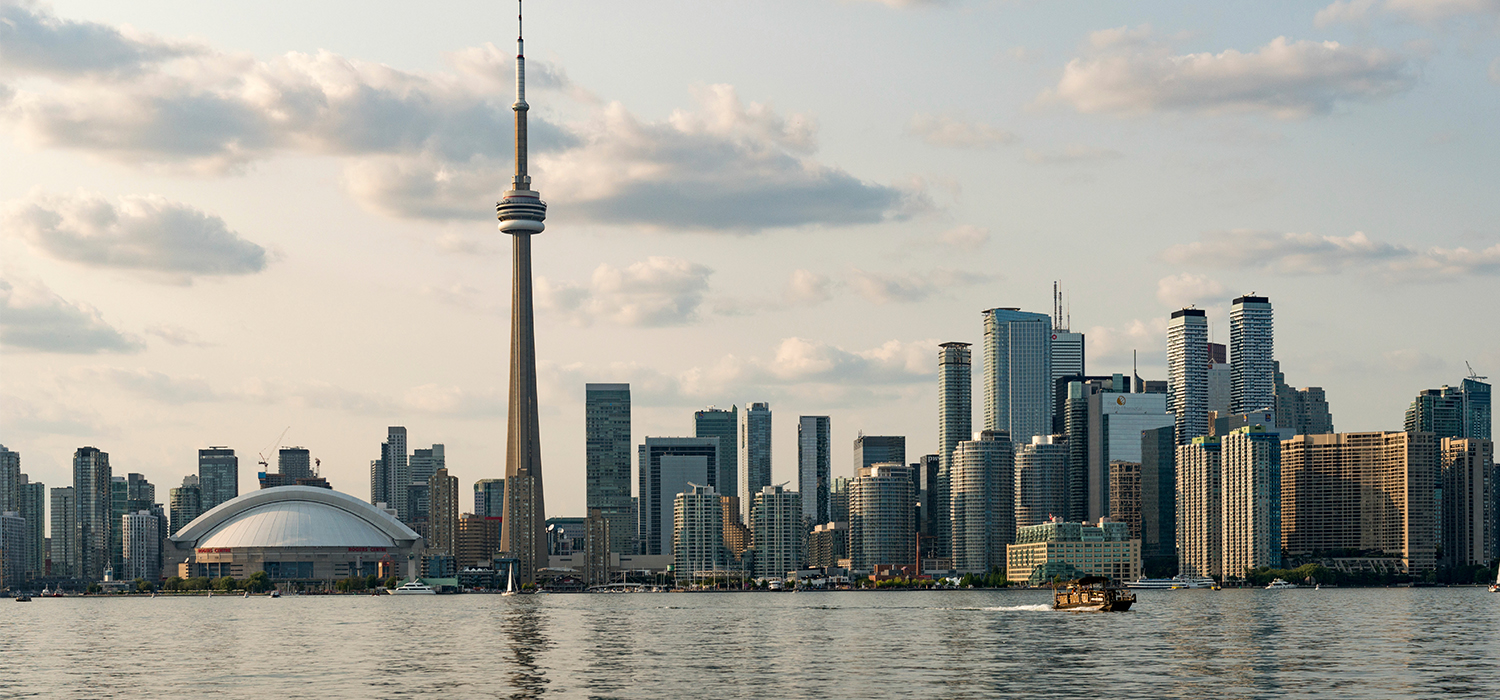
Toronto
Toronto is the provincial capital of Ontario and the most populous city in Canada, with an estimated population of 2,956,024 (2018) and an estimated population of 6,341,935 in the Toronto Region (2018.)Located on the shores of the western end of Lake Ontario, Toronto is also the anchor of the Golden Horseshoe, an urban agglomeration of 9,245,438 (2016)that accounts for a significant portion of Canada's economic activity and more than 20% of Canada's population. Toronto is an international centre of business, finance, arts, and culture. Its large population of immigrants from around the globe has also made Toronto one of the most multicultural and cosmopolitan cities in the world
Population:2.93 millions
Population:2.93 millions
Montreal
Montreal e largest city in the Quebec province in Canada and the second most populous in the country.2 It is also an administrative region of Quebec. It is located on the island of the same name between the Saint Lawrence River and the Rivière des Prairies. It is one of the main industrial, commercial and cultural centers of North America.
Montreal is the fourth most populous French-speaking city in the world, behind Paris, Kinshasa and Abidjan. However, Montreal also has a considerable Anglophone community, and a growing number of people whose native language is not even French. not english.
Population: 1.78 Million
Population: 1.78 Million

Vancouver
Vancouver is a city on the Pacific coast of Canada, located in the southwest of the province of British Columbia, between the Strait of Georgia and the Coastal Mountains. The city was named after Captain George Vancouver, an English explorer.
It is part of the Greater Vancouver Regional District metropolitan area, which, with a population of 2,331,328 inhabitants constitutes the largest metropolitan area in western Canada and the third in the country after Toronto and Montreal. Vancouver itself has 603 502 inhabitants.The gentilicio used to refer to Vancouver residents is vancuverita or vancouverense.
Vancouver, in recent years, has always been considered one of the five cities with the best quality of life in the world. In 2013, it was ranked 21st among the cities in which it is more expensive to live and turned out to be the most expensive North America is also one of the safest cities in the world, due to its extremely low crime rates.

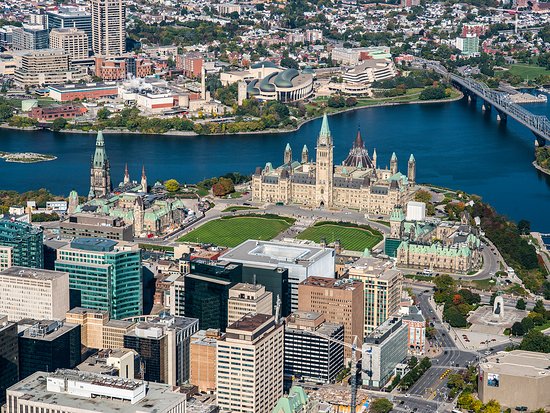
Ottawa
Ottawa is the capital of Canada and the fourth largest city in the country. It is located in the extreme southeast of the province of Ontario, on the banks of the Ottawa River, which forms the border between the provinces of Ontario and Quebec. It is located approximately 400 kilometers east of Toronto and 200 kilometers west of Montreal.
According to the census, the city has 1,083,391 inhabitants, although adding the population of the suburbs the number rises to 2,148,785.1 Although the Anglophone population predominates, there is a significant Francophone population (32.6%) . In addition, all the municipal services of the city are bilingual (English and French).
On December 31, 1857 the city was chosen by Queen Victoria of the United Kingdom to be the capital of Canada, for being a neutral territory in view of the English and French-speaking communities. It also has a significant distance from the border of the United States of America, which at the time was planning to invade the British colonies to the north.
City of Quebec
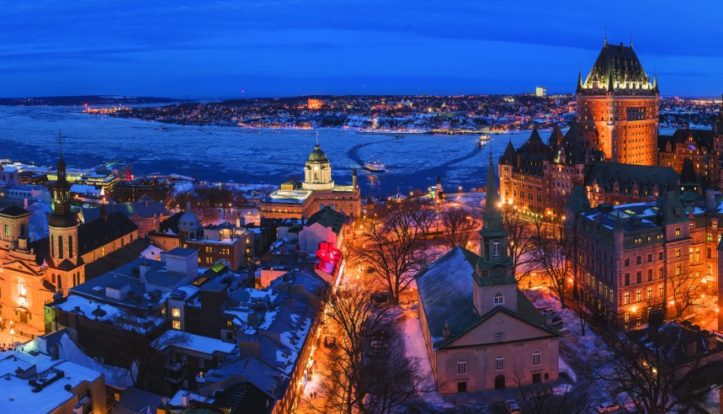
Quebec is the capital of the province of Quebec, located in eastern Canada. Founded by Samuel de Champlain in 1608. Its historic center, an 18th-century French-style walled compound (known as Vieux-Québec), was declared a World Heritage Site by UNESCO in 1985.
With a population of 531,902 inhabitants in 2016 according to Statistics Canada and with data from the 2011 census, the city is the ninth largest in the country, the second in the province of the same name by population and the 50th Canadian municipality by area. The metropolitan area - the Metropolitan Community of Quebec - encompasses 27 municipalities reaching 752,000 spread over an area of 3,347.12 km². The city celebrated its 400th anniversary in 2008.
It is the second most populous city in the province of Quebec after Montreal.
It is located on the banks of the San Lorenzo river around a hill where the Château Frontenac hotel (Frontenac Castle) rises.

ECONOMY
Canada's economy as a wealthy society with a high-tech industry, and an economy with a GDP of over one trillion dollars, Canada resembles the United States' economic market system and its pattern of production and construction. Since World War II, the impressive growth of manufacturing, mining, and the service sector has transformed the nation from a rural economy to a mainly industrial and urban one. The Free Trade Agreement with the United States, which was signed in 1989, and later, the creation of NAFTA (North American Free Trade Agreement NAFTA also known as NAFTA or NAFTA (for its acronym in English North American Free Trade Agreement) or ALÉNA.), which includes Mexico, has produced a surprising increase in trade and greater economic integration with the United States.
With its many natural resources, a skilled workforce and modern capital, Canada has a strong economy. With a sound fiscal administration, it has produced a budget surplus, substantially reducing the national debt, although a new challenge is managing the increasing costs of the public health system. Exports represent a third of GDP. Like Mexico, Canada enjoys a super avit that represents the total of 500 million dollars in 2015. Canada is completely POmul, receiving 85% of its exports, with a GDP that exceeds one trillion dollars.
In 2015, the Canadian economy was in recession due to the fall in oil, since oil and natural gas represent 10% of its GDP.

Rivers
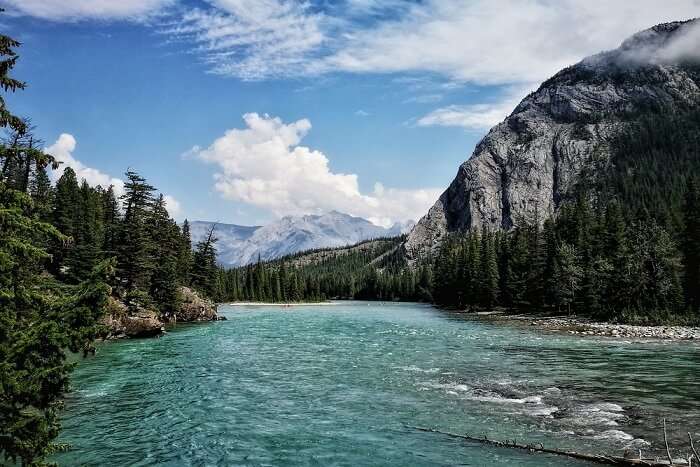
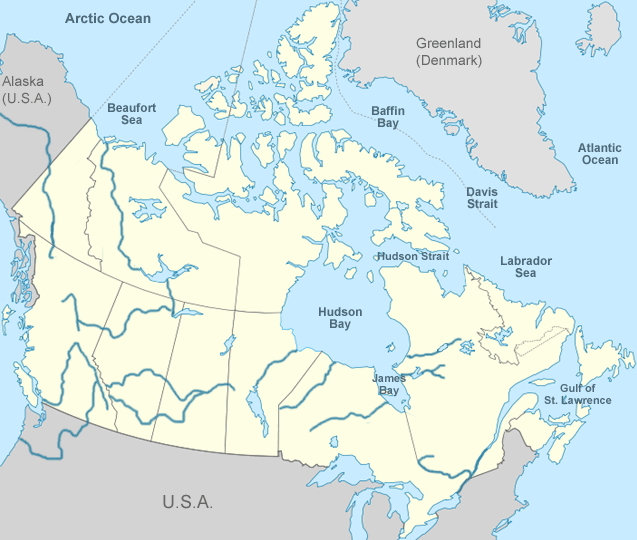
Fraser River (1,370 km), is born in the Rocky Mountains and empties into the Pacific. It is the longest river in British Columbia.
Columbia River (2,044 km), is born in Lake Columbia (British Columbia) and empties into the Pacific after touring the North American states of Oregon and Washington. In terms of flow, it is the largest river among those flowing into the Pacific Ocean from North America, and the second longest river from the United States. It is also the river that produces the largest amount of hydroelectric power in North America.
Koksoak River (874 km), which flows into Ungava Bay, in the Hudson Strait, in Quebec.
Mackenzie River, which runs through the Northwest Territories. It is the longest Canadian river, with 4,241 km. Its flow, of 10,300m³ / s, is equivalent to that of San Lorenzo. It flows into the Beaufort Sea, north of the Northwest Territories.
Nelson River (660 km), runs from Lake Winnipeg to Hudson Bay in Manitoba.´
WEATHER
Canada Climate: Humid Continental
The most extensive climate in Canada is the humid continental. It is also the climate of the most inhabited regions of the country, especially in the Great Lakes. This Canadian climate is characterized by abundant rainfall and cold, contrasting temperatures. Winters are cold or very cold and relatively dry. Summers tend to be hot and rainy.
Torono, the most populous city in Canada, has this type of climate.
Canada Climate: Temperate Maritime Influence
It is the climate that affects British Columbia, the westernmost province in the country. As is the case in Vancouver.
Winters are hotter and rainier. By cons, summers are drier. Temperatures are mild, though cool. The thermal amplitude is quite small.
Climate of Canada: Semi-arid climate
It acts to leeward of the Rocky Mountains and to the South of these. It is a climate with an influence of almost zero air masses. The mountain range acts as a barrier. In this way it is a climate that receives very little rain. Summers are mild and winters are cold and very severe.
Climate of Canada: Subarctic
It is the climate that affects the extreme north of Canada. In most of this territory there are permanent ice areas. Temperatures tend to almost always be below freezing. The precipitations are little, although always in the form of snow. Strong shallow blizzards are the tonic.
Canada Weather: Spring
Spring in Canada runs from March to June approximately. Strong frosts are usually maintained until late March. The days start to get longer and warmer. Although the nights are still cool. The rains begin to have a greater presence as well.
Canada Weather: Summer
Summer begins in mid-June and ends in late August or early September. The weather is already warm and can reach temperatures of 30ºC during the day. In the central region (Quebec and Ontario) and especially in areas of the Great Lakes, the environment is much more humid and thunderstorms are common.
Canada Weather: Autumn
During the Fall (September to November) the climate of Canada is cool and quickly turns cold. The first frosts begin. Although during the day the thermometer can reach 10ºC or 12ºC.
It is a time when enough rain falls. Sometimes with great intensity. The first snowfalls also begin to fall, generally from November.
Canada Weather: Winter
Winter begins in December in Canada. The extremely low temperatures and heavy snowfall are the keynote. So it is perhaps the most feared season. During the day it can be around 0ºC although at night they can drop several degrees below zero. The cold air masses accentuate this sensation of cold.
The snow usually lasts from November to mid-March or early April.
The further north of the country, the winters are longer and more extreme. In addition, the hours of sunshine are considerably reduced.
![Clima de Canadá | Conoce cómo es en sus principales ciudades [2020 ]](https://growproexperience.com/wp-content/uploads/2017/10/Estaciones-del-a%C3%B1o.jpg)
LIMITS
It is located in the extreme north of the American continent. It limits the south with EE. USA, to the North with the Arctic Glacier Ocean, to the East with the Atlantic Ocean, and to the West with the Pacific Ocean and the USA.
Ottawa is the capital of Canada and the fourth largest city in the country. It is located in the extreme southeast of the province of Ontario, on the banks of the Ottawa River, which forms the border between the provinces of Ontario and Quebec. It is located approximately 400 kilometers east of Toronto and 200 kilometers west of Montreal.
According to the census, the city has 1,083,391 inhabitants, although adding the population of the suburbs the number rises to 2,148,785.1 Although the Anglophone population predominates, there is a significant Francophone population (32.6%) . In addition, all the municipal services of the city are bilingual (English and French).
On December 31, 1857 the city was chosen by Queen Victoria of the United Kingdom to be the capital of Canada, for being a neutral territory in view of the English and French-speaking communities. It also has a significant distance from the border of the United States of America, which at the time was planning to invade the British colonies to the north.
City of Quebec
Quebec is the capital of the province of Quebec, located in eastern Canada. Founded by Samuel de Champlain in 1608. Its historic center, an 18th-century French-style walled compound (known as Vieux-Québec), was declared a World Heritage Site by UNESCO in 1985.
With a population of 531,902 inhabitants in 2016 according to Statistics Canada and with data from the 2011 census, the city is the ninth largest in the country, the second in the province of the same name by population and the 50th Canadian municipality by area. The metropolitan area - the Metropolitan Community of Quebec - encompasses 27 municipalities reaching 752,000 spread over an area of 3,347.12 km². The city celebrated its 400th anniversary in 2008.
It is the second most populous city in the province of Quebec after Montreal.
It is located on the banks of the San Lorenzo river around a hill where the Château Frontenac hotel (Frontenac Castle) rises.
Quebec is the capital of the province of Quebec, located in eastern Canada. Founded by Samuel de Champlain in 1608. Its historic center, an 18th-century French-style walled compound (known as Vieux-Québec), was declared a World Heritage Site by UNESCO in 1985.
With a population of 531,902 inhabitants in 2016 according to Statistics Canada and with data from the 2011 census, the city is the ninth largest in the country, the second in the province of the same name by population and the 50th Canadian municipality by area. The metropolitan area - the Metropolitan Community of Quebec - encompasses 27 municipalities reaching 752,000 spread over an area of 3,347.12 km². The city celebrated its 400th anniversary in 2008.
It is the second most populous city in the province of Quebec after Montreal.
It is located on the banks of the San Lorenzo river around a hill where the Château Frontenac hotel (Frontenac Castle) rises.
ECONOMY
Canada's economy as a wealthy society with a high-tech industry, and an economy with a GDP of over one trillion dollars, Canada resembles the United States' economic market system and its pattern of production and construction. Since World War II, the impressive growth of manufacturing, mining, and the service sector has transformed the nation from a rural economy to a mainly industrial and urban one. The Free Trade Agreement with the United States, which was signed in 1989, and later, the creation of NAFTA (North American Free Trade Agreement NAFTA also known as NAFTA or NAFTA (for its acronym in English North American Free Trade Agreement) or ALÉNA.), which includes Mexico, has produced a surprising increase in trade and greater economic integration with the United States.
With its many natural resources, a skilled workforce and modern capital, Canada has a strong economy. With a sound fiscal administration, it has produced a budget surplus, substantially reducing the national debt, although a new challenge is managing the increasing costs of the public health system. Exports represent a third of GDP. Like Mexico, Canada enjoys a super avit that represents the total of 500 million dollars in 2015. Canada is completely POmul, receiving 85% of its exports, with a GDP that exceeds one trillion dollars.
In 2015, the Canadian economy was in recession due to the fall in oil, since oil and natural gas represent 10% of its GDP.
Rivers
Fraser River (1,370 km), is born in the Rocky Mountains and empties into the Pacific. It is the longest river in British Columbia.
Columbia River (2,044 km), is born in Lake Columbia (British Columbia) and empties into the Pacific after touring the North American states of Oregon and Washington. In terms of flow, it is the largest river among those flowing into the Pacific Ocean from North America, and the second longest river from the United States. It is also the river that produces the largest amount of hydroelectric power in North America.
Koksoak River (874 km), which flows into Ungava Bay, in the Hudson Strait, in Quebec.
Mackenzie River, which runs through the Northwest Territories. It is the longest Canadian river, with 4,241 km. Its flow, of 10,300m³ / s, is equivalent to that of San Lorenzo. It flows into the Beaufort Sea, north of the Northwest Territories.
Nelson River (660 km), runs from Lake Winnipeg to Hudson Bay in Manitoba.´
WEATHER
Canada Climate: Humid Continental
The most extensive climate in Canada is the humid continental. It is also the climate of the most inhabited regions of the country, especially in the Great Lakes. This Canadian climate is characterized by abundant rainfall and cold, contrasting temperatures. Winters are cold or very cold and relatively dry. Summers tend to be hot and rainy.
Torono, the most populous city in Canada, has this type of climate.
Canada Climate: Temperate Maritime Influence
It is the climate that affects British Columbia, the westernmost province in the country. As is the case in Vancouver.
Winters are hotter and rainier. By cons, summers are drier. Temperatures are mild, though cool. The thermal amplitude is quite small.
Climate of Canada: Semi-arid climate
It acts to leeward of the Rocky Mountains and to the South of these. It is a climate with an influence of almost zero air masses. The mountain range acts as a barrier. In this way it is a climate that receives very little rain. Summers are mild and winters are cold and very severe.
Climate of Canada: Subarctic
It is the climate that affects the extreme north of Canada. In most of this territory there are permanent ice areas. Temperatures tend to almost always be below freezing. The precipitations are little, although always in the form of snow. Strong shallow blizzards are the tonic.
Canada Weather: Spring
Spring in Canada runs from March to June approximately. Strong frosts are usually maintained until late March. The days start to get longer and warmer. Although the nights are still cool. The rains begin to have a greater presence as well.
Canada Weather: Summer
Summer begins in mid-June and ends in late August or early September. The weather is already warm and can reach temperatures of 30ºC during the day. In the central region (Quebec and Ontario) and especially in areas of the Great Lakes, the environment is much more humid and thunderstorms are common.
Canada Weather: Autumn
During the Fall (September to November) the climate of Canada is cool and quickly turns cold. The first frosts begin. Although during the day the thermometer can reach 10ºC or 12ºC.
It is a time when enough rain falls. Sometimes with great intensity. The first snowfalls also begin to fall, generally from November.
Canada Weather: Winter
Winter begins in December in Canada. The extremely low temperatures and heavy snowfall are the keynote. So it is perhaps the most feared season. During the day it can be around 0ºC although at night they can drop several degrees below zero. The cold air masses accentuate this sensation of cold.
The snow usually lasts from November to mid-March or early April.
The further north of the country, the winters are longer and more extreme. In addition, the hours of sunshine are considerably reduced.

Comentarios
Publicar un comentario